



Unleashing the Power of Motion Control in Robotic Precision
Industrial robots, with their integration of motion components and their assimilation into work cells with other motion-based automated equipment, are creating quite the buzz in the modern tech world. These robotic work cells often include conveyors, vision systems, and machines, all geared towards automating specific tasks. But what sets a robot apart from a machine when it comes to motion systems? What is the difference between the motion systems used in automated machines and those in robots?
Motion control enables new levels of robotic precision. Source: AdobeStock
Understanding Motion Systems in Robots and Machines
Robots are capable of executing complex, programmable, and reconfigurable movement sequences. This differs from machines, such as vending machines, which are designed for a singular, well-defined use in a fixed location. They may perform tasks on different parts, but are unlikely to be reprogrammed for multiple purposes. In contrast, robotics, in the form of Cartesian robotics, include assemblies of linear motion components for various adaptive functions.
Technologies Behind Different Robot Types
Articulated and SCARA robotics, as well as Cartesian systems, share common gear, motor, and control technologies. Even automated guided vehicles (AGVs) use similar technologies. However, strategies differ when it comes to synchronizing multi-axis movement with robot kinematics. The goal is to reduce latency, complexity, and costs associated with material handling, machine maintenance, and other setups integrating robotics alongside other types of motion systems.
Suppliers of Motion Components Also Supply Robots
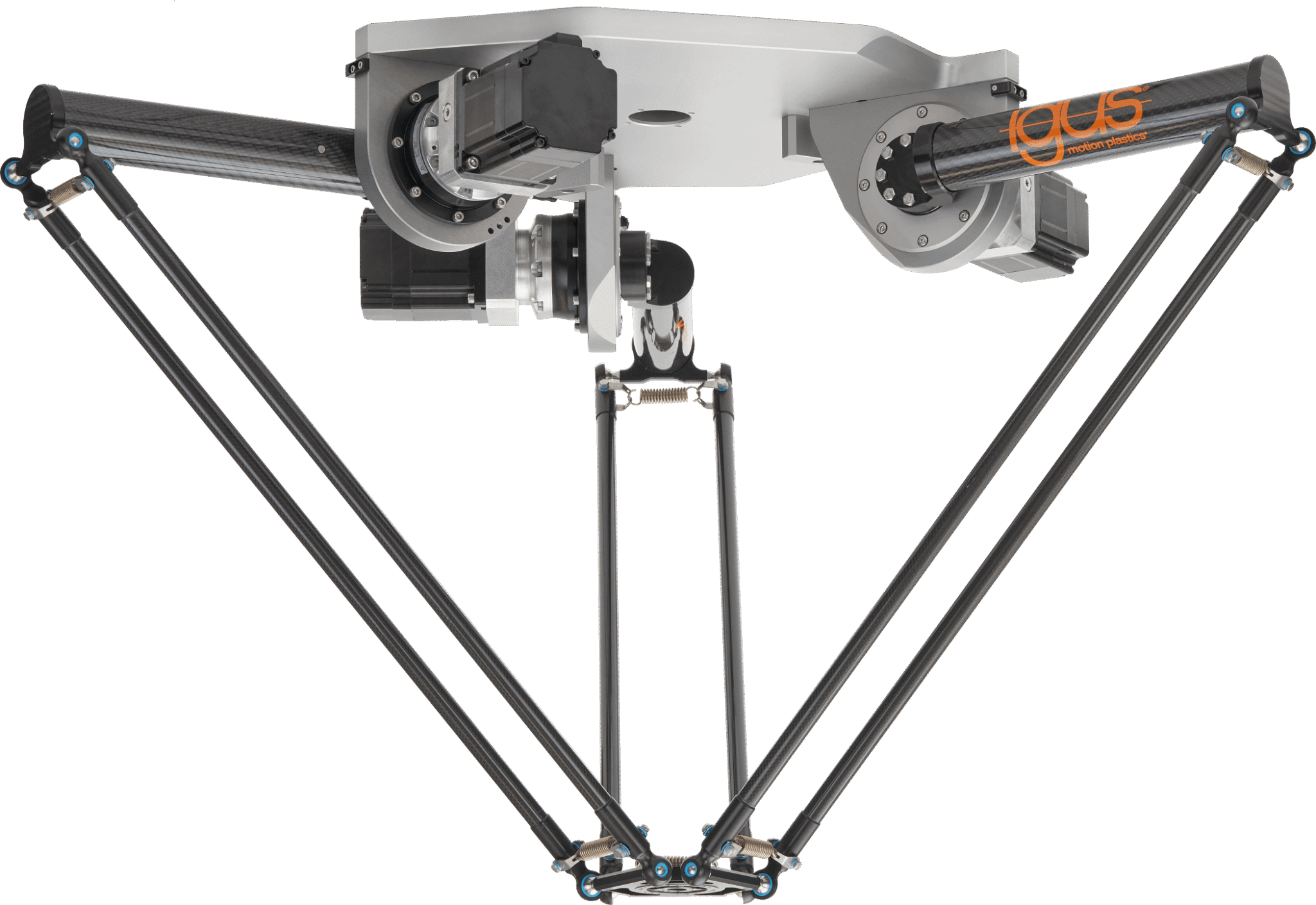
A three-DoF RBTX delta robot. Source: igus
Since robotics is just a subset of motion system design, many motion component suppliers offer their own fully pre-integrated robots. These suppliers also support the design and integration of robotics with subsystems suitable for robotic operations. Even down to the smallest components, including washers, spacers, shims, and fasteners, these elements hold the assembly together while preventing stacking errors that can cause galling, angular misalignment, or tool center drift.
Delta Robots: Unique Kinematics and Dynamics
Delta or Spider robots, with their distinctive kinematics featuring NEMA stepper screw actuators or belt drives on each link, are a breed apart. Many industrial grade deltas, such as those used for transfer tasks, are equipped with permanent magnet servo motors for each parallel link.
The Versatility of Robotic Arms
Articulated robotic arms, featuring six degrees of freedom (DoF), are what most people imagine when thinking of an industrial robotic arm. These arms excel at maneuvering workpieces across stations and unaligned surfaces, with a working envelope constrained by the joints. Their overall repeatability at the end effector depends on its position in space, with the farthest reaches having the worst values. Therefore, it’s best to position objects well within reach and without requiring any articulation to adopt a fully upright posture.
SCARA Systems and Their Movement Capabilities
Selective Compliance Assembly Robot Arms (SCARA) are another type of articulated system with serial connections. Particularly effective for pick and place tasks, SCARAs are often used in operations requiring modest to moderate flow and where the installation does not warrant much customization. They can be purchased as ready-to-use, three or four DoF solutions, or the kinematics lend themselves to in-house builds.
SCARAs, like other articulated robots, often have convenient passages for power supply, encoder signals, I/O wiring, and pneumatic lines from the base to the end effector. Industrial SCARA joints typically include AC servo motors with absolute encoders for position feedback even when main power is turned off and on. Battery-free encoders can help make SCARA compact, and they are further enhanced by the use of planetary gearboxes which provide torsional rigidity and efficiency with joint-friendly compactness.
Editor’s note: This article is distributed from The Robot Report’s sister site, Design World.
Source: Here

