


Understanding Uncertainty in Machine Learning: Probabilities and Noise
Welcome to the final installment of our series on visualizing the foundations of machine learning. In this article, we will delve into the complex yet crucial concepts of uncertainty, probabilities, and noise in the realm of machine learning.
Uncertainty is an inherent aspect of machine learning, arising whenever models make predictions about real-world outcomes. It signifies a lack of complete knowledge about an outcome and is commonly quantified using probabilities. Rather than being a hindrance, uncertainty is a factor that models must address to generate reliable and dependable predictions.
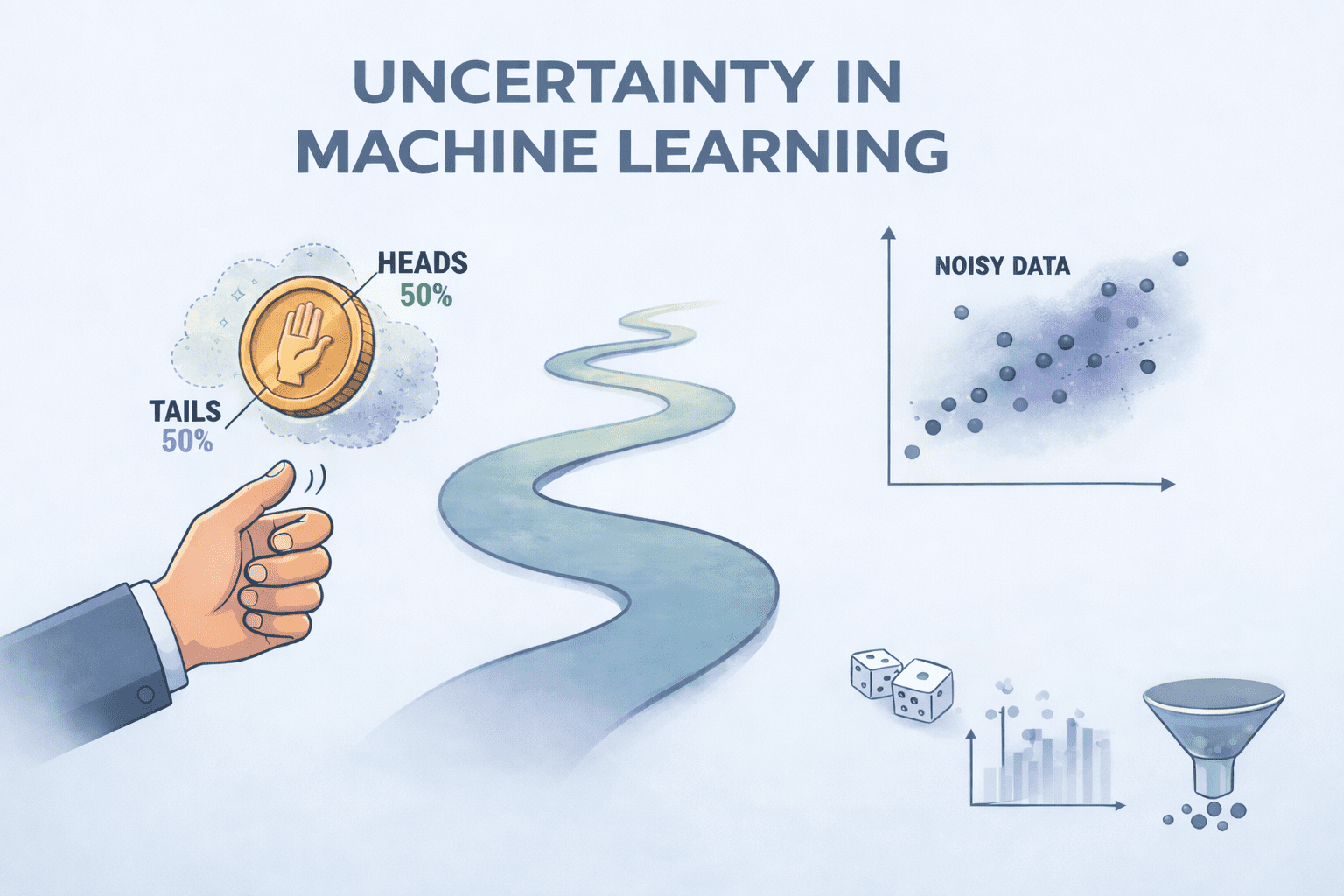
One way to conceptualize uncertainty is through the perspective of probability and the unknown. Similar to flipping a coin, where the outcome is uncertain despite well-defined probabilities, machine learning models often operate in environments where multiple outcomes are possible. As data traverses a model, predictions branch out in various directions, influenced by randomness, incomplete information, and data variability.
The key to managing uncertainty lies in measuring and understanding it. This involves grasping the fundamental elements of probability and noise:
- Probability: serves as a mathematical framework for expressing the likelihood of an event occurring.
- Noise: refers to irrelevant or random variations in data that obscure the true signal, which can be either random or systematic.
These components collectively shape the uncertainty present in a model’s predictions.
It’s important to note that not all uncertainties are equal. Random uncertainty stems from the intrinsic randomness of data and cannot be diminished, even with additional information. Conversely, Epistemic uncertainty arises from a lack of knowledge about the model or data generation process and can often be reduced by acquiring more data or enhancing the model. Distinguishing between these two types is crucial for interpreting model behavior and determining strategies for improvement.
To address uncertainty, machine learning practitioners employ several tactics. Probabilistic models generate complete probability distributions instead of singular estimates, making uncertainty explicit. Ensemble methods amalgamate predictions from multiple models to minimize variance and enhance uncertainty estimation. Additionally, Data cleaning and validation further enhance reliability by reducing noise and rectifying errors before training.
Uncertainty is an intrinsic component of real-world data and machine learning systems. By acknowledging its origins and integrating them directly into modeling and decision-making processes, practitioners can develop models that are not only more accurate but also more resilient, transparent, and trustworthy.
Machine Learning Mastery Resources
For further insights into probability and noise, consider exploring the following resources:
- A gentle introduction to uncertainty in machine learning – This article elucidates the concept of uncertainty in machine learning, delves into major causes such as data noise, incomplete coverage, and imperfect models, and explains how probability offers the tools necessary to quantify and manage uncertainty. Access the article here.
- Machine Learning Probability (7 Day Mini Course) – This intensive course guides participants through essential probability concepts essential for machine learning, covering basic probability types, distributions, Naive Bayes, and entropy, with practical lessons designed to bolster confidence in applying these concepts using Python. Access the course here.
- Understanding Probability Distributions for Machine Learning with Python – This tutorial introduces crucial probability distributions utilized in machine learning, demonstrates their application in tasks like residual modeling and classification, and furnishes Python examples to aid practitioners in comprehending and effectively utilizing them. Access the tutorial here.
Stay tuned for upcoming entries in our series on visualizing the foundations of machine learning.

