


Introduction
AI agents play a crucial role in various industries, requiring long-term memory to handle complex tasks efficiently. The debate between vector databases and RAG graphs as memory architectures for AI agents has been ongoing. Understanding the differences between these two approaches is essential for developers to make informed decisions on which is best suited for their specific needs.
Vector Databases: The Foundation of Semantic Agent Memory
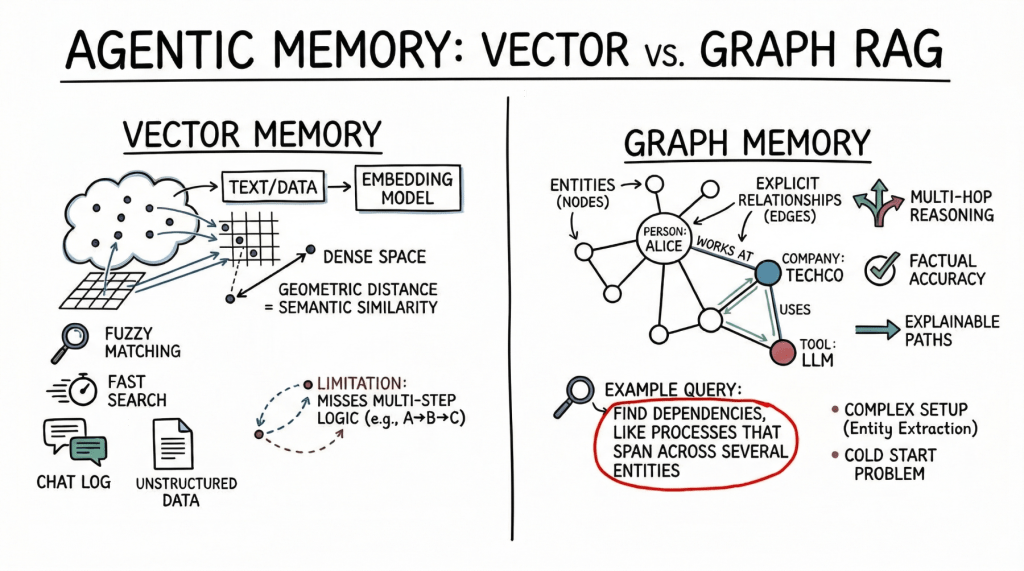
Vector databases store and retrieve semantically similar unstructured information using dense embeddings in high-dimensional space. These databases are ideal for fast search and flexible matching, making them popular for storing conversation history and retrieving relevant documents for AI agents. However, they have limitations in handling multi-step logic and noisy results, which can affect the accuracy of the retrieved information.
Graph RAG: Structured Context and Relational Memory
RAG graphs combine knowledge graphs with extended language models to represent entities and relationships in a structured manner. This approach excels at complex reasoning and provides high accuracy in retrieving explicit relationships. However, implementing a RAG graph requires robust entity extraction pipelines and ontologies, making it more complex and time-consuming compared to vector databases.
The Comparison Framework: When to Use Which
Vector databases are best suited for unstructured data and broad similarity matching, while RAG graphs are ideal for structured data and precise relationship retrieval. Developers should consider the inherent structure of their data and expected query patterns when choosing between these two approaches. A hybrid architecture combining both methods can provide the benefits of semantic search and structured memory for advanced agent systems.
Conclusion
Vector databases are a practical choice for general-purpose agent memory, offering ease of deployment and semantic matching capabilities. However, for complex workflows requiring precise reasoning and factual accuracy, the RAG graph emerges as a valuable advancement. Developers can benefit from a layered approach, starting with a vector database and gradually introducing knowledge graphs for enhanced context recovery.
Vector Databases and Graph RAG for Agent Memory: When to Use Which
Image by author

