



Self-hosting AI began as a side curiosity for me and has evolved into a staple part of my tech stack. Primarily, I’ve leveraged it for text-related tasks such as chatting, brainstorming, document parsing, and image analysis when deploying vision models like Gemma 4. However, local AI for real design work presented a different challenge.
Local AI couldn’t match the capabilities of Claude Design, Google Stitch, or Replit, and for generative art, it was leagues behind Midjourney or Firefly. When I discovered ComfyUI, I was thrilled to find a local solution capable of generating visuals on my hardware. Open Design then redefined what local visual AI means for me. It’s the first tool that allows me to design locally, a feature I didn’t know I needed.
Want to stay in the loop with the latest in AI? The XDA AI Insider newsletter drops weekly with deep dives, tool recommendations, and hands-on coverage you won’t find anywhere else on the site. Subscribe by modifying your newsletter preferences!
ComfyUI was my only local option for visuals
But it’s not exactly a tool for designers
ComfyUI is an open-source, node-based interface for running open-weight image models like Stable Diffusion and Flux. It allows users to build the generation pipeline by connecting blocks on a canvas, each handling tasks like model loading, prompt encoding, sampling, and decoding. The platform operates locally and is community-driven, ensuring it receives model support updates swiftly compared to closed alternatives.
For a long time, ComfyUI was my sole realistic option for generating visuals locally, whether design-adjacent or not. I developed an appreciation for the node setup as it facilitated UI/UX thinking practice by constructing a flow with inputs, outputs, dependencies, and a clear order of operations, akin to wireframing logic. Despite not frequently using the outputs, I enjoyed experimenting with the graphs.
The limitation was in the output. ComfyUI could produce static visuals suitable as mockup placeholders, but it couldn’t generate something interactive or editable. The quality was also limited by my 8GB GPU, resulting in placeholder visuals that weren’t particularly strong. While ComfyUI introduced an App Builder feature for simplified app interfaces, the outputs remained static images or videos, not editable prototypes.
Open Design finally gave me local design
Closer to a real design workflow than anything else I’ve run locally
Claude Design has been my go-to for vibe designing, alongside Figma Make and Google Stitch in my cloud workflow. Having design integrated into Claude is convenient since I’m already using it for other tasks. However, with a significant portion of my workflow being offline, Open Design arrived at an opportune moment, especially following Anthropic’s Claude Design launch.
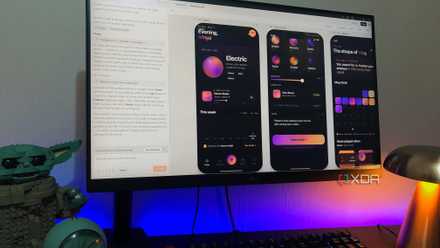
Open Design operates as a native desktop app across macOS, Windows, and Linux, unlike the cloud-only Claude Design. It outputs real HTML/CSS/JS artifacts, with export options for HTML, PDF, PPTX, and MP4. It doesn’t have its own model but instead utilizes any coding agent CLI on your system or any OpenAI-compatible endpoint, which I opted for. It comes with over 250 skills and 140 design systems.
I’ve had success locally by pointing it at Qwen 3.5 9B through LM Studio’s API, with satisfactory results on my modest machine. However, Gemma 4 didn’t perform well, echoing broken XML skill templates, likely due to a vision-vs-agentic-work mismatch and limited VRAM. For superior performance, cloud models remain advantageous, where the Anthropic API excels with fast, high-quality outputs.
Visual doesn’t equal useful
Visual local AI is a category, not a goal
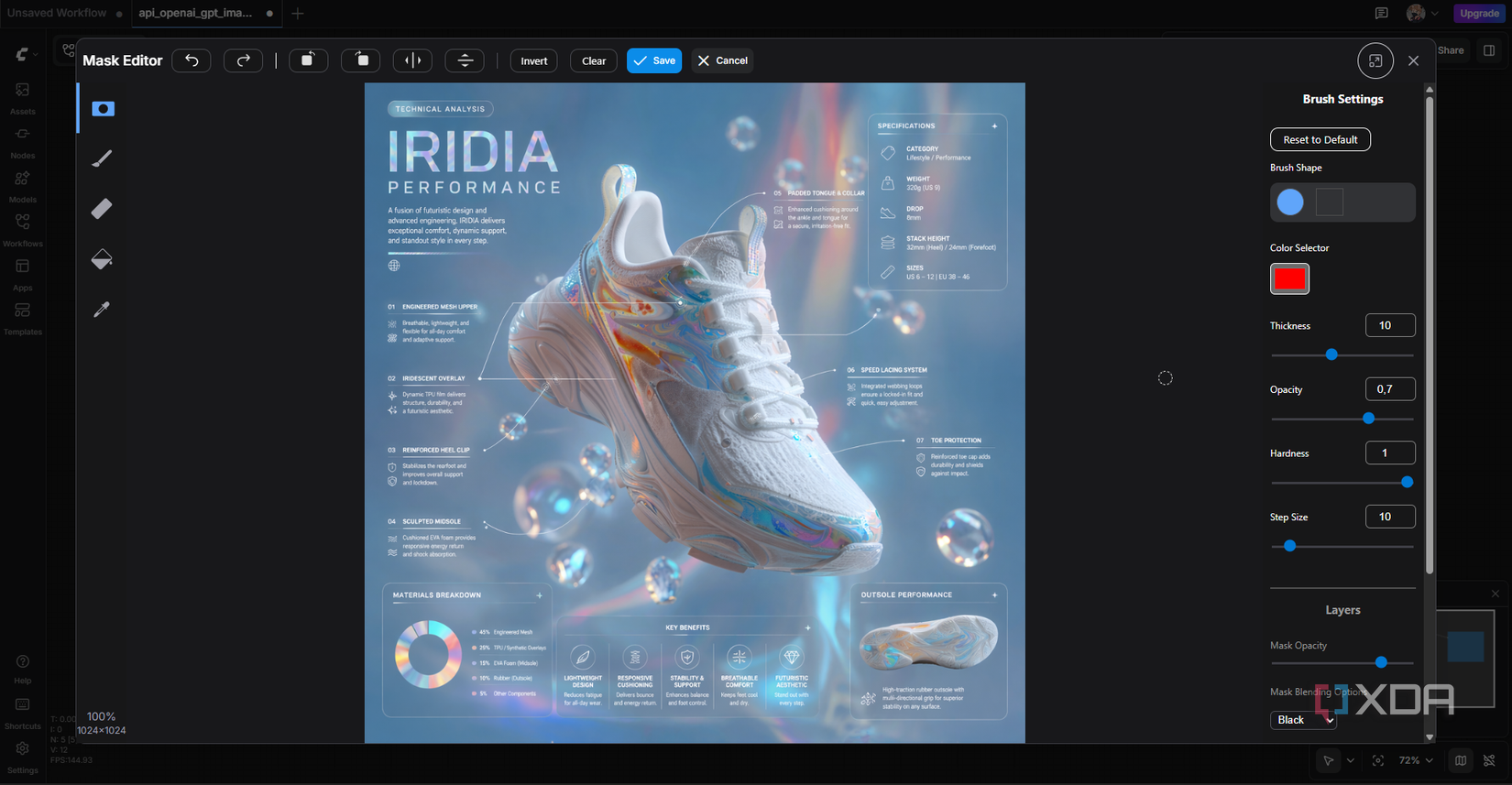
While ComfyUI serves the purpose if you specifically need a generated image and nothing more, its appeal was more about the setup than the output for me. Not every visual tool fits seamlessly into a design pipeline.
Open Design aligns better with my needs, and its setup is significantly easier than ComfyUI’s. Connecting a model takes minutes, and generation is faster using natural language instead of nodes. In a fast-paced deadline environment, there’s little time for node graph construction.
The right kind of visual matters
ComfyUI remains a solid tool for anyone keen on local image generation, but it’s not always the right tool for every project. Open Design fulfills a local design need I wasn’t aware of, and its existence is remarkable. Both tools continue to have a place on my machine.
For more information, visit the source: Here.
“`

